
Air Duct Cleaning • Homeowner Guide • Nationwide
Why Are My Air Vents So Dusty? 8 Causes & What to Do
You wipe the air vent clean. A few days later, that gray layer is back. Maybe there is a dusty ring around the grille. Maybe you can actually see particles when the AC turns on.
The natural reaction is: “Are my air ducts filthy?” Sometimes dirty ductwork is part of the problem. But surprisingly often, the vent is showing you a problem somewhere else in the HVAC system.
Dusty air vents do not automatically mean you need air duct cleaning. Dust may collect because of normal household particles, a dirty or poorly fitted HVAC filter, gaps around the register, leaking return ducts, pets, renovation dust, or actual buildup inside the duct system. The most important clue is whether dust is simply collecting on the vent or is actually coming out of the vent.
Not sure which one you are dealing with?
United Duct Care offers a free air duct system inspection and estimate. We can inspect the system, explain what we find, and provide an estimate for any cleaning or repairs that may be needed. There is no obligation to move forward with the service. Request a free inspection.
First: Is the Dust ON the Vent or Coming OUT of It?
This is the first question we would ask because these two situations can point in very different directions.
Dust ON the vent
A light coating on the grille—especially on a return vent—can simply be household dust collecting where air repeatedly passes through.
Dust coming OUT of the vent
If you can see particles, debris, or little clouds being discharged from a supply vent when the system starts, that deserves more investigation.
A dusty grille by itself is not proof that the entire duct system is contaminated. That is why it is worth doing a little troubleshooting before assuming the solution is duct cleaning.
| What You Notice | What It May Point To |
|---|---|
| Light dust on a return grille | Normal household dust accumulation may be contributing. |
| Dark or dusty outline around vent edges | Air may be moving through gaps around the register or boot. |
| Several vents become dusty very quickly | Check filtration, return leakage, and whole-system dust sources. |
| Visible particles blow out when HVAC starts | The duct system or HVAC components may deserve inspection. |
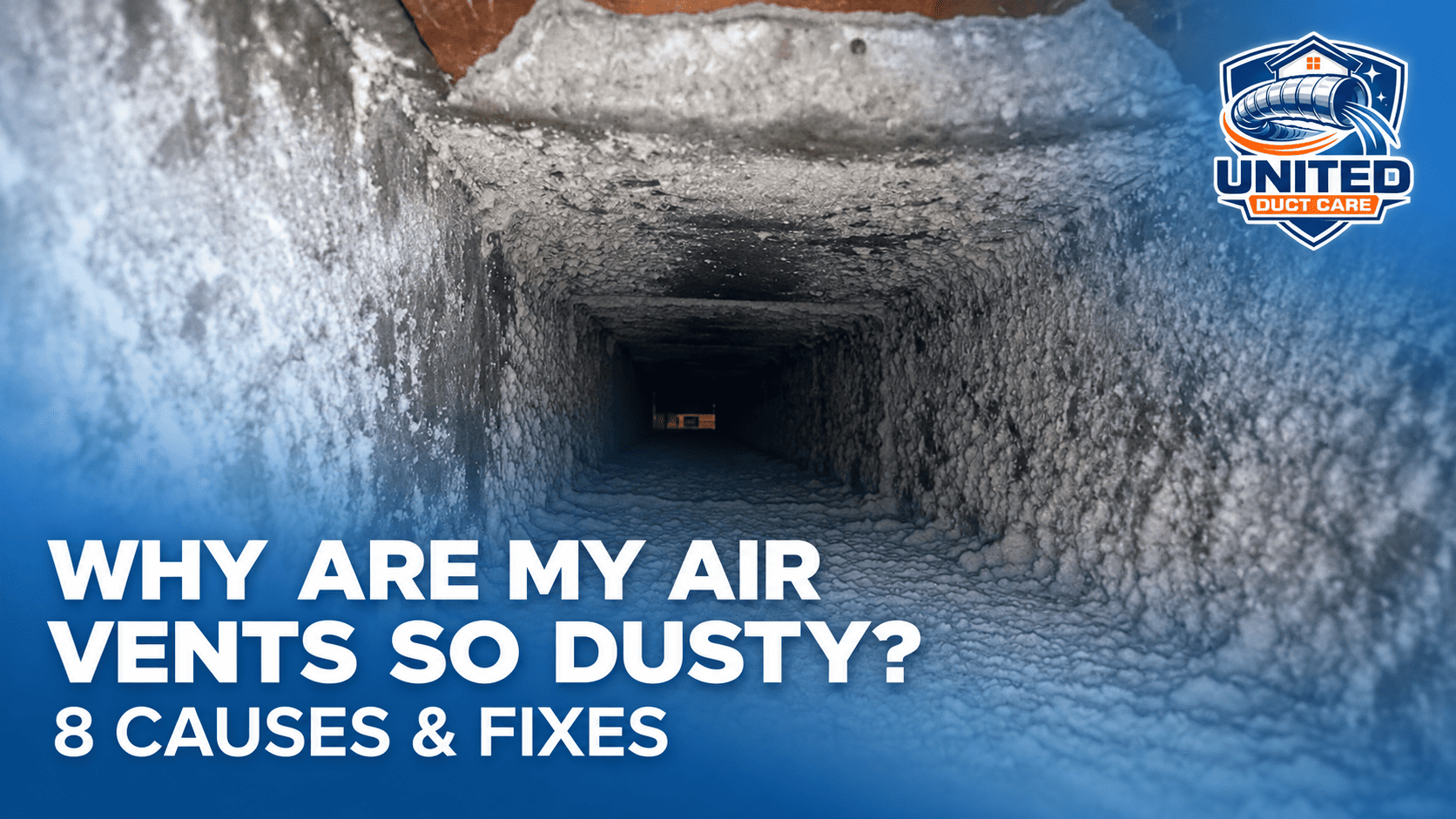
| Chunks or debris visible inside the opening | There may be accumulated debris inside an accessible duct section. |
| Dust plus moisture, staining, or musty odor | Investigate the moisture source instead of treating this as ordinary dust. |
8 Reasons Your Air Vents Keep Getting Dusty
Start with the simple causes first. In many homes, the explanation is much less dramatic than people expect.
Every home contains airborne particles: fabric fibers, tracked-in soil, skin flakes, pet material, cooking particles, and outdoor dust that enters when doors and windows open.
Your HVAC system constantly moves room air. A return grille can become one of the places where those particles visibly collect.
Clue: If the buildup is light, mostly on a return grille, and develops slowly, ordinary household dust may be doing most of the work.
Before blaming the ductwork, check the filter. A clogged filter is only one possibility. The filter can also be the wrong size, poorly fitted, bowed, damaged, or installed in a way that allows air to travel around it.
If air bypasses the filter, particles that should have been captured can continue through the HVAC system.
Do this: Check whether the filter sits snugly in its slot and follow the HVAC manufacturer or filter manufacturer's replacement guidance.
Before You Blame Your Ducts, Check This First
- Is the filter visibly overloaded with dust?
- Is it the correct physical size?
- Are there gaps around the edges?
- Is the filter bent or collapsing?
- Is the airflow arrow facing the correct direction?
- Has your home recently had construction or unusually heavy dust?
Higher-efficiency filtration can capture smaller particles, but do not automatically install the highest-rated filter you can find. Your HVAC system must be able to handle the filter's airflow resistance.
Look closely at the edge of the vent. Does the dust form a neat dark halo around the perimeter?
The duct boot behind the register should meet the ceiling, floor, or wall properly. Gaps can allow air movement around the edges of the register, creating a surprisingly visible dust pattern.
Clue: A distinct dusty outline around the register may tell you more about air leakage near the opening than about dirt deep inside the duct.
This is one of the causes homeowners often miss. Return ductwork pulls air back toward the HVAC equipment. If a return duct has a leak in an attic, crawlspace, garage, or other dusty area, the system may pull unwanted particles into the airflow.
Those particles can then move through the system and contribute to dust around supply vents and inside the home.
Clue: Several vents becoming dusty at roughly the same time can point to a system-level issue rather than one dirty register.
Drywall sanding, drilling, demolition, flooring work, cutting wood, and other renovation jobs produce large amounts of fine dust.
If the HVAC system operated while the work was happening, some of that dust may have been drawn toward return vents, settled around registers, or entered accessible parts of the system.
Clue: If the dusty-vent problem began immediately after remodeling, that timing matters.
Homes with pets often have more hair, dander, tracked-in debris, and other particles moving through the living space.
That does not mean every pet owner's ducts are dirty. It simply means the HVAC filter, return grilles, and nearby surfaces may collect material more quickly—especially during heavy shedding.
Sometimes the obvious explanation is the correct one. Dust, construction debris, or other material can accumulate in parts of a duct system.
The strongest clue is not simply dust sitting on the face of a grille. It is visible material inside the duct opening or particles actually being discharged from supply registers.
That is when an inspection becomes much more useful than guessing.
Ordinary gray dust and a damp, musty, stained, or fuzzy-looking vent are not the same situation.
If moisture is present, the source of that moisture needs attention. Simply wiping the vent or cleaning dust without addressing the moisture can allow the underlying problem to continue.
Clue: Dust plus persistent moisture or a musty odor deserves separate investigation.
Try This: The 5-Minute Dusty Vent Test
Before paying anybody—or assuming the worst—do this simple check. You do not need to dismantle your HVAC system.
Use a damp microfiber cloth so you have a clean starting point.
Look at its condition, fit, size, and whether there are obvious gaps that could allow air to bypass it.
Without reaching deep into the system, look for light dust, heavy buildup, chunks, or unusual debris in the accessible area.
If only the return grille looks dusty, the situation may be different from debris appearing at several supply registers.
Do you actually see particles coming out, or is the grille simply dusty?
If the same heavy pattern returns unusually fast, you now have useful evidence that something should be investigated.
One Dusty Vent vs. Every Vent: This Clue Matters
Only one vent is dusty
Think local problem first.
- Gap around that register
- Dustier room
- Nearby renovation work
- Loose vent cover
- Localized duct issue
Many vents are dusty
Think upstream or whole-system issue.
- HVAC filter
- Return-side leakage
- Heavy household dust
- Renovation contamination
- System-wide debris
How Fast Does the Dust Come Back?
This may be one of the most useful questions in the entire diagnosis.
A light layer developing gradually may simply be normal household dust accumulation.
If a freshly cleaned vent gets heavily dusty again very quickly, investigate filtration and possible air leakage.
If particles are actually discharged from supply vents, inspecting the duct/HVAC system is more reasonable.
Does a Dusty Vent Mean I Need Air Duct Cleaning?
Not automatically. This is important because a reputable duct cleaning company should not tell every homeowner with a dusty grille that an expensive cleaning is immediately required.
Cleaning becomes more reasonable to investigate when there is evidence that the problem extends beyond ordinary dust sitting on the vent cover.
An inspection may make sense if:
- You can see heavy buildup inside accessible duct openings
- Particles are visibly being released from supply vents
- Dust returns unusually fast after cleaning the grille
- Several supply vents show the same problem
- The home recently went through heavy renovation or construction
- You suspect a damaged or leaking duct section
- There are signs of pests or nesting debris
- There is a persistent musty odor or moisture problem that needs investigation
If you want to learn more about the service itself, visit our Air Duct Cleaning page.
Still Wondering Where the Dust Is Coming From?
You do not have to guess. United Duct Care offers a free air duct cleaning inspection and estimate.
We can inspect your air duct system, look for visible dust and debris, check the areas relevant to the problem, and identify cleaning or repair needs that are apparent during the inspection.
- Inspection: We examine the air duct system.
- Explanation: We explain what we find.
- Estimate: You receive an estimate for recommended cleaning or repairs.
- Your decision: If you like the estimate, you can move forward.
- No obligation: If you do not want the service, you can simply say no.
How to Keep Your Air Vents From Getting Dusty So Quickly
You cannot eliminate household dust completely. But you can reduce how quickly it builds up around the HVAC system.
Follow the filter and equipment manufacturer's guidance and inspect the filter more often during periods of heavy dust, renovation, or pet shedding.
A good filter cannot do its job properly if air is constantly bypassing the edges.
Vacuuming and wiping accessible grilles can prevent a small dust layer from turning into a thick one.
Furniture, boxes, and other obstructions can interfere with the airflow the HVAC system was designed to use.
Construction dust spreads farther than most homeowners expect. Protecting the living space and HVAC system during dusty work can help avoid problems afterward.
If the vent boot is separated from the ceiling or wall, or accessible duct connections appear loose, fixing the air leakage may matter more than repeatedly wiping the grille.
If you see staining, condensation, or persistent dampness, identify the moisture source rather than simply cleaning the surface.
When Should You Have the System Professionally Inspected?
You do not need a professional every time a vent has a little dust. But some patterns are worth investigating.
- Dust or debris is visibly coming out of supply vents
- Multiple vents become dirty unusually quickly
- You can see substantial debris inside accessible duct openings
- The problem started after renovation or construction
- You suspect duct leakage from an attic or crawlspace
- Airflow has noticeably changed in several rooms
- You see evidence of pest activity
- Dust is accompanied by moisture or a persistent musty odor
The goal of an inspection should be to identify what is actually happening before deciding what service, if any, makes sense.
Sometimes the Right Answer Is: You Do Not Need Duct Cleaning
If your only issue is a thin layer of normal dust collecting slowly on a return grille, professional duct cleaning may not be the first thing you need.
On the other hand, if dust is being discharged from supply vents, buildup is visible deeper in the accessible ductwork, or there are signs of leakage, renovation debris, pests, or moisture, an inspection can help determine the cause.
That distinction matters. The goal should be solving the actual problem—not selling a service simply because a vent looks dusty.
Frequently Asked Questions
Why do my air vents get dusty so fast?
Fast dust buildup can be related to a heavily loaded or poorly fitted HVAC filter, air leakage around a register, dusty return-air leakage, renovation debris, pets, unusually dusty indoor conditions, or actual material inside the duct system. Clean one vent and observe how quickly the buildup returns.
Is dust around air vents normal?
Some dust accumulation can be normal, particularly around return-air grilles where household air is being pulled back toward the HVAC system. Heavy buildup, rapid recurrence, or debris being blown from supply vents deserves more investigation.
Does a dusty vent mean my air ducts are dirty?
No. A dusty grille by itself does not prove that the entire duct system is heavily contaminated. Check the filter, vent edges, location of the dust, and whether particles are actually being discharged before drawing that conclusion.
Why does dust come out of my vents when the AC turns on?
Visible particles coming from a supply vent may indicate loose dust or debris in an accessible duct section, contamination introduced during renovation, air leakage elsewhere in the system, or another HVAC issue. If it happens repeatedly, consider having the system inspected.
Can a dirty air filter cause dusty vents?
A heavily loaded filter can contribute to HVAC and airflow problems, but filter fit is important too. If the filter is undersized or air is bypassing its edges, particles may move through the system instead of being captured as intended.
Why is there black dust around my air vents?
Dark buildup around a vent can have several causes, including accumulated household particles and airflow-related deposits. Color alone should not be used to identify mold or another specific contaminant. If the material is unusual, damp, spreading, or accompanied by a strong odor, have the source investigated.
Can leaking air ducts make my house dusty?
They can contribute. In particular, return-side leaks in dusty unconditioned areas such as attics or crawlspaces can allow unwanted particles to enter the air path.
Can I clean my air vents myself?
Homeowners can generally vacuum and wipe accessible vent covers and grilles. Avoid pushing tools deep into ductwork or taking apart HVAC components unless you know what you are doing. If substantial debris is deeper in the system, an inspection is a safer starting point.
How often should I change my HVAC filter?
There is no single replacement interval that fits every home. Filter type, HVAC use, pets, household dust levels, renovation work, and manufacturer recommendations all matter. Inspect the filter regularly and follow the guidance for your specific filter and system.
Does United Duct Care offer a free air duct inspection?
Yes. United Duct Care offers a free air duct system inspection and estimate. We inspect the system and provide an estimate for cleaning or repairs that may be needed. If you want to proceed with the service, you can. If you do not, there is no obligation to move forward.
Small note: HVAC systems and duct layouts vary by home. Visible dust can have several causes, so photographs and surface appearance alone may not identify the exact source. When there is persistent heavy buildup, moisture, damage, pest activity, or debris being discharged from vents, a system inspection can provide better information.
Tired of Guessing Why Your Vents Keep Getting Dusty?
Start with an inspection—not an assumption. United Duct Care offers a free air duct inspection and estimate. We inspect the system, explain what we find, and provide an estimate for any cleaning or repairs we recommend.
If you want the service, move forward. If not, simply say no. The decision is completely yours.
Request Free Inspection Call (855) 769-4568
Helpful links: Air Duct Cleaning • Dryer Vent Cleaning • Chimney Cleaning